



18 Best DevOps MCP Servers
TL;DR:
- Model Context Protocol (MCP) is the open standard introduced by Anthropic at the end of 2024, which lets AI agents use different tools using natural language
- This article covers 18 relevant MCP servers in the DevOps space across Infrastructure as Code, CI/CD, Containers and Kubernetes, observability, cloud, and incident management
- Most of these servers work with the majority of AI assistants that you use, such as Claude, OpenAI, Gemini, or any compatible ones
- Whenever you are adopting a new MCP server, start with read-only permissions, and scope access carefully before giving write access to production systems
Watch the video instead:
Version Control and CI/CD
1. GitHub MCP Server
GitHub’s MCP Server is the most widely deployed DevOps MCP in the ecosystem. This is largely because GitHub is the most popular version control system. The GitHub MCP Server enables AI agents to browse and search code, create and update issues, open, comment on, and merge pull requests, and even trigger CI/CD workflows through GitHub Actions.
You can easily ask your agent to review PRs for security issues, check recent commits to understand the specifics of changes to a particular file, or even triage issues by label and assignee.
It supports a --read-only flag that prevents any mutations.
2. GitLab MCP Server
Another popular version control and CI/CD MCP server is GitLab’s MCP Server offering. This is very useful if your teams live in GitLab and they manage their repositories and pipelines there.
Similar to GitHub’s offering, it lets your AI agents interact with your projects, by creating and updating issues, merging PRs, and even interacting with your GitLab CI/CD pipelines.
3. Azure DevOps MCP Server
If your organization is running Azure DevOps, the MCP server it offers covers the full platform from repositories to work items, builds, releases, and more.
The ADO MCP Server is maintained by Microsoft and it is actively developed. It offers support for directory-based authentication switching and multi-project management. This is very useful especially if you are managing multiple ADO projects under a single organization.
Honorable mentions: Jenkins MCP Server
Docker and Kubernetes
4. Docker Hub MCP Server
Docker Hub server billions of monthly image downloads and hosts over 10 million container images. Finding the right image inside this catalog can be a cumbersome task, as you need to either go through the web UI, or run multiple docker search commands.
With the Docker Hub MCP server, you can use natural language to enable content discovery, and at the same time, repository management.
At the same time, with Docker Desktop you get access to more than 200 MCP servers that run directly in Docker, by using the Docker MCP Toolkit.
5. Kubernetes MCP Server
The containers/kubernetes-mcp-server supports Kubernetes and OpenShift, and it is available as a native binary, an npm package, a Python package, and even as a container image.
With this server, your AI agent has full clusters visibility, so you can ask plain-English questions like “Why is this pod failing”, and the agent will come up with a root cause analysis by correlating logs and events, and it will also show you how to solve the issue or apply it automatically.
The downside to this MCP server is that it doesn’t work natively with cloud providers clusters, so you need to actually have them in your kubeconfig before interacting with them.
6. Lens MCP Server
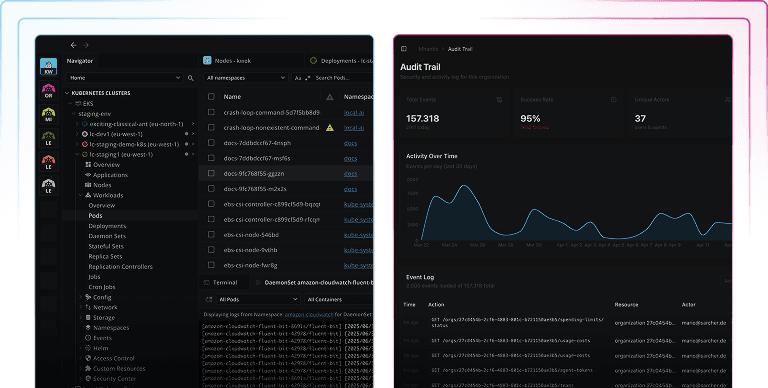
The Lens MCP Server takes Kubernetes management from AI assistants to the next level. Because Lens integrates natively with AWS EKS and Azure AKS, the Lens MCP Server can connect directly to your EKS and AKS clusters, without needing to add them in your kubeconfig.
At the same time, if you are using the Lens Teamwork feature, the Lens MCP Server will have access to all the clusters that are available in your Lens Teamwork Spaces.
Example configuration for Claude Code:
{
"mcpServers": {
  "lens": {
    "command": "lens",
    "args": [
      "mcp-server"
    ]
  }
}
}
7. ArgoCD MCP Server
With the ArgoCD MCP server, your AI assistants can interact with ArgoCD applications through natural language.
You can list all the clusters that are registered with ArgoCD, list/create/update/delete applications, and also do resource management.
Example usage in Claude Desktop:
{
 "mcpServers": {
   "argocd-mcp": {
     "command": "npx",
     "args": [
       "argocd-mcp@latest",
       "stdio"
     ],
     "env": {
       "ARGOCD_BASE_URL": "<argocd_url>",
       "ARGOCD_API_TOKEN": "<argocd_token>"
     }
   }
 }
}
Honorable mentions: Flux CD MCP Server
Infrastructure as Code
8. Terraform MCP Server
If you are managing your Terraform code using Terraform Cloud, you can leverage HashiCorp’s Terraform MCP server to interact with all your resources from your AI assistant.
With the MCP Server, you can manage your workspaces, trigger runs, inspect your state, do cost estimations, and even registry browsing.
9. Spacelift Intent
Spacelift Intent is an MCP server that lets you manage infrastructure resources directly from your AI assistants.
You can create/update/delete resources and also import resources that were created outside of your IaC processes. With Spacelift Intent you also ensure that all the resources that were created with AI are tracked, so you can easily manage their lifecycle,
10. AWS MCP Server
The AWS MCP Server (currently in Preview Mode) lets you get real-time AWS knowledge, troubleshoot issues, provision and configure infrastructure and also manage costs.
This server merges the capability of two existing servers: AWS Knowledge MCP and the AWS API MCP, offering a unified interface that reduces configuration complexity.
11. Azure MCP Server
The Azure MCP Server lets you connect your AI agents to your Azure Services. The Azure DevOps MCP server handles the CI/CD side, so this server helps you with your resource management.
If you are an Azure shop, using these two MCP servers together will unlock an end to end workflow for your infrastructure management.
Honorable mentions: Pulumi MCP Server, AWS IaC MCP Server
Observability
12. Grafana MCP Server
With the Grafana MCP Server, your AI assistant can query data from your dashboards, inspect your data sources, and even retrieve incident details.
Grafana has optimized how the server structures responses to minimize the context windows usage and to reduce the token costs.
Example configuration for Claude Desktop:
{
 "mcpServers": {
   "grafana": {
     "command": "uvx",
     "args": ["mcp-grafana"],
     "env": {
       "GRAFANA_URL": "http://localhost:3000",
       "GRAFANA_SERVICE_ACCOUNT_TOKEN": "<your service account token>"
     }
   }
 }
}
13. Prometheus MCP Server
The Prometheus MCP server translates natural language queries into PromQL and executes it against your Prometheus instance.
Instead of writing complex PromQL, you can just ask your AI assistants to show you different kinds of errors like “show me all 500 error rates for the API server over the last 10 minutes”, and the agent handles the query for you.
14. Datadog MCP Server
The Datadog MCP Server gives agents access to metrics, logs, traces, and incident management, all through a single interface.
For organizations that are already paying for Datadog, this server removes a lot of context-switching and can be extremely useful during incident response.
Honorable mentions: Sentry MCP server
Security
15. Trivy MCP Server
With the Trivy MCP Server you can enable natural language scanning into your container images, and your infrastructure code.
Trivy MCP server integrates vulnerability scanning, misconfiguration detection, secret scanning into your resources, and it also supports optional integration with the Aqua Platform for enhanced scanning capabilities.
16. Prowler MCP Server
Prowler is one of the most widely used open-source cloud security platforms, and its MCP server is capable of detecting misconfigurations, assessing risks, and automatically generating or submitting remediation pull requests.
Example configuration:
{
 "mcpServers": {
   "prowler": {
     "type": "streamable-http",
     "url": "https://mcp.prowler.com/mcp"
   }
 }
}
17. Wiz MCP Server
If your organization is running Wiz for cloud security posture management (CSPM), you can use the Wiz MCP server to bring that security context into your development workflow.
The MCP Server also enhances Wiz Code by translating natural language queries into complement remediation workflows.
18. Snyk MCP Server
Snyk’s MCP Server is part of the Snyk CLI, which makes it pretty straightforward to get it running. The Snyk MCP server allows MCP-enabled agentic tools to Snyk security scanning capabilities directly.
With this MCP Server, you can use Snyk scans for code, different configurations, and dependencies, retrieving the results directly into your MCP-enabled tool.
Honorable Mentions: PagerDuty MCP Server, Semgrep MCP Server
Best practices before adopting any MCP Server
Before you start adopting MCP Servers, and using them in your sensitive environments, you need to keep a couple of things in mind:
- Each server operates with whatever permissions you configure to it; Start with read-only permissions, and offer write capabilities only when you are certain that the agent works as you expect it.
- Don’t give write access to production databases, as the blast radius for an error here can cripple your enterprise
- Configure dedicated service accounts, and IAM roles with leas-privilege policies, rather than reusing your own credentials
Conclusion
The DevOps MCP ecosystem has grown rapidly over the last 1.5 years. Right now there is a broad ecosystem of enterprise-based and community-maintainted servers covering every major part of the DevOps toolchain.
While some claim that MCP is dead, and CLI tooling replaces it, the numbers tell a different story. PulseMCP alone indexes over 12k MCP servers, and that’s after filtering out low quality implementations. In addition to that, the Linux Foundation stewards the MCP protocol since the end of 2025, which is rarely the kind of thing that happens to dying technologies.
You shouldn’t pick between MCP and CLI, you should understand that the two aren’t mutually exclusive.
If you want to manage your Kubernetes clusters easier, give Lens MCP Server a try.