


What is Platform Engineering? A Practical Guide for Kubernetes Teams
TL;DR:
- Platform engineering transforms your internal infrastructure into a product, and software developers are your customers
- Internal Developer Platforms (IDPs) help you abstract infrastructure complexity (Kubernetes included) behind self-service portals and golden paths, and also implements automated governance
- Gartner projects that 80% of large enterprises will have dedicated platforms teams by 2026
- Backstage, ArgoCD, Crossplane, Kyverno, Lens Kubernetes IDE and others form the backbone of a modern IDP stack on Kubernetes
Why does Platform Engineering matter right now?
Platform engineering has grown massively during the last few years. What started as a topic that tried to make infrastructure more accessible to developers, has now evolved into a fully automated system that implements all the guardrails necessary to ensure your organization stays compliant.
KubeCon Europe 2026 had a dedicated Platform Engineering Day, a full BackstageCon, an OpenTofu day, KyvernoCon, ArgoCon, and other events that are related to platform engineering as well. The adoption of platform engineering is real, and this CNCF survey shows that over 28% of organizations have a dedicated platform team, while Gartner projects that 80% of large enterprises will have dedicated platform teams by the end of 2026.
So what is the main driver for adopting platform engineering?
There are three main reasons:
- DevOps without structure doesn’t scale: If you are in a small organization, each engineer can own and operate their own CI/CD pipelines and infrastructure. This will work perfectly fine. At scale, however, things change. Having each of your team assemble their own infrastructure tools and practices will create fragmentation and inconsistency.
- AI-generated code is accelerating software delivery, but governance can’t keep up: The speed vs control paradox is real. Especially now when AI-generated code is in every repository. The need for having a platform that enforces governance rules is more important than ever, as it can take automated decisions for code that violates your standards, without needing human reviews. This reduces fatigue in your engineers.
- Cognitive load is affecting all engineers: When a software developer is deploying a single microservice he needs to walkthrough Kubernetes manifests, Terraform/OpenTofu code, ArgoCD configurations, Vault policies, Prometheus monitoring rules, Kyverno policies and more. This is simply unsustainable in the long run.
With platform engineering you are actually shifting this model that doesn’t work at scale anymore. By leveraging platform engineering, you have a dedicated platform team that builds and maintains the shared infrastructure layer as a product, making it easy for others to use it, while making sure that all guardrails are in play.
What are the Key Concepts in Platform Engineering?
Before jumping in and explaining how a modern Platform looks like, it’s important to understand some of the key concepts you will work with:
- Internal Developer Platform (IDP): This is the full stack of your platform, the product that platform teams ship to their customers (Terraform/OpenTofu code, GitOps tools, Kubernetes manifest, Self-service blueprints, and more)
- Internal Developer Portal: This is typically the frontend interface where developers interact with the platform. Backstage which is now a CNCF project is the most adopted open-source option. This is just a portal, but without Golden Paths, and policy engines into play, this is just a simple catalog with no inventory.
- Golden Paths: These are blueprints that help you with deploying your infrastructure and ensuring you have all the guardrails you need to achieve security and compliance. By clicking a button, you can deploy a microservice with all the necessary monitoring, security policies, and application configuration. Golden Paths are usually built upon self-service infrastructure.
- Self-service infrastructure: With self-service infrastructure you let your developers provision infrastructure on their own, without them needing to fill in provisioning tickets, or waiting on your DevOps/Platform Engineering teams.
How does a modern IDP Stack look like for Kubernetes
There are a couple of layers you need to implement in order to have an IDP Stack for Kubernetes.
1. Developer Portal Layer
The most dominant choice right now is Backstage. It comes packed with a software catalog in which you can register different components that can be used by your developers. At the same time, it offers software templates (think of them as golden paths) that can scaffold new services with CI/CD pipelines, Kubernetes manifests, and monitoring all built in.
Backstage also has a plugin ecosystem that lets you extend the portal with cost dashboards, security scanning results, and others. In addition to that it offers TechDocs for documentation as code that lives alongside your source, and can be seen directly in the portal.
Note: Backstage is powerful, but you need engineering resources to build, customize, and maintain your Backstage instance. There are commercial alternatives available like Port, Cortex, and Humanitec that you can check out.
2. GitOps and Deployment Layer
For Kubernetes, the most popular choices for implementing GitOps are ArgoCD and Flux. These tools ensure that you use Git as your source truth for your Kubernetes cluster state and they equip you with automated and auditable deployments, drift detection and remediation, and also environment promotion workflows.
If you want to learn more about GitOps with ArgoCD and Flux, check out this article.
3. Infrastructure Provisioning Layer
Terraform and OpenTofu are the most popular infrastructure provisioning choices. Even if you live in the Kubernetes world 90% of the time, these tools have been battle-tested and there are many other tools in the ecosystem that make them work.
On the other hand, if you want a Kubernetes native way to provision your infrastructure, Crossplane is a good alternative.
If you want to learn more about Crossplane, and how it can help you with multi-cloud scenarios, check out this article.
4. Policy and Security Layer
When it comes to policy as code for Kubernetes, Kyverno offers a native YAML way to enforce your organization rules, while Open Policy Agent (OPA), can help you enforce your rules with a language called rego.
At the same time, if you need to scan your code for misconfigurations, and vulnerabilities, Trivy from Aqua Security, can be a great choice for your organization.
If you want to see what the top 12 Kubernetes Security tools in 2026 are, check out this article.
5. Observability Layer
Prometheus, Grafana, OpenTelemetry, and integrations with Slack/MS Teams, can help you understand, at a glance, if something is wrong in your Kubernetes clusters. Your platform needs to surface the right data in the right context, and a developer shouldn’t have to switch to Grafana or write PromQL to understand why their service is unhealthy.
6. AI Layer
In 2026, AI is present in almost everything that is done in tech. Knowing how to use it properly, will make the difference between platforms that solve the speed-control paradox, and those that don’t.
Here are some articles that show you how you can implement the AI layer in your platform:
- Learn how to manage all your Kubernetes clusters from any AI assistant
- Top 18 MCP Servers
- Best AI tools for Kubernetes
Where does Lens Kubernetes IDE fit in the IDP Stack
Even if you have Backstage, golden paths, GitOps, Policies, and Security implemented, your developers still need to interact with Kubernetes directly.
Deployments fail, pods crash, resource limits need tuning, services misbehave, and when that happens, the developer portal is just a starting point for debugging, not the answer.
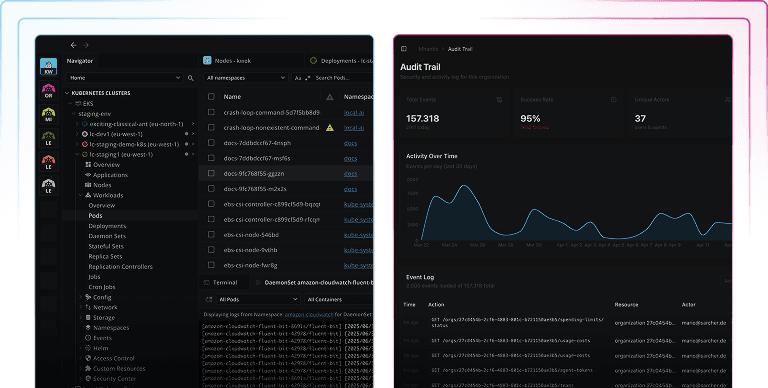
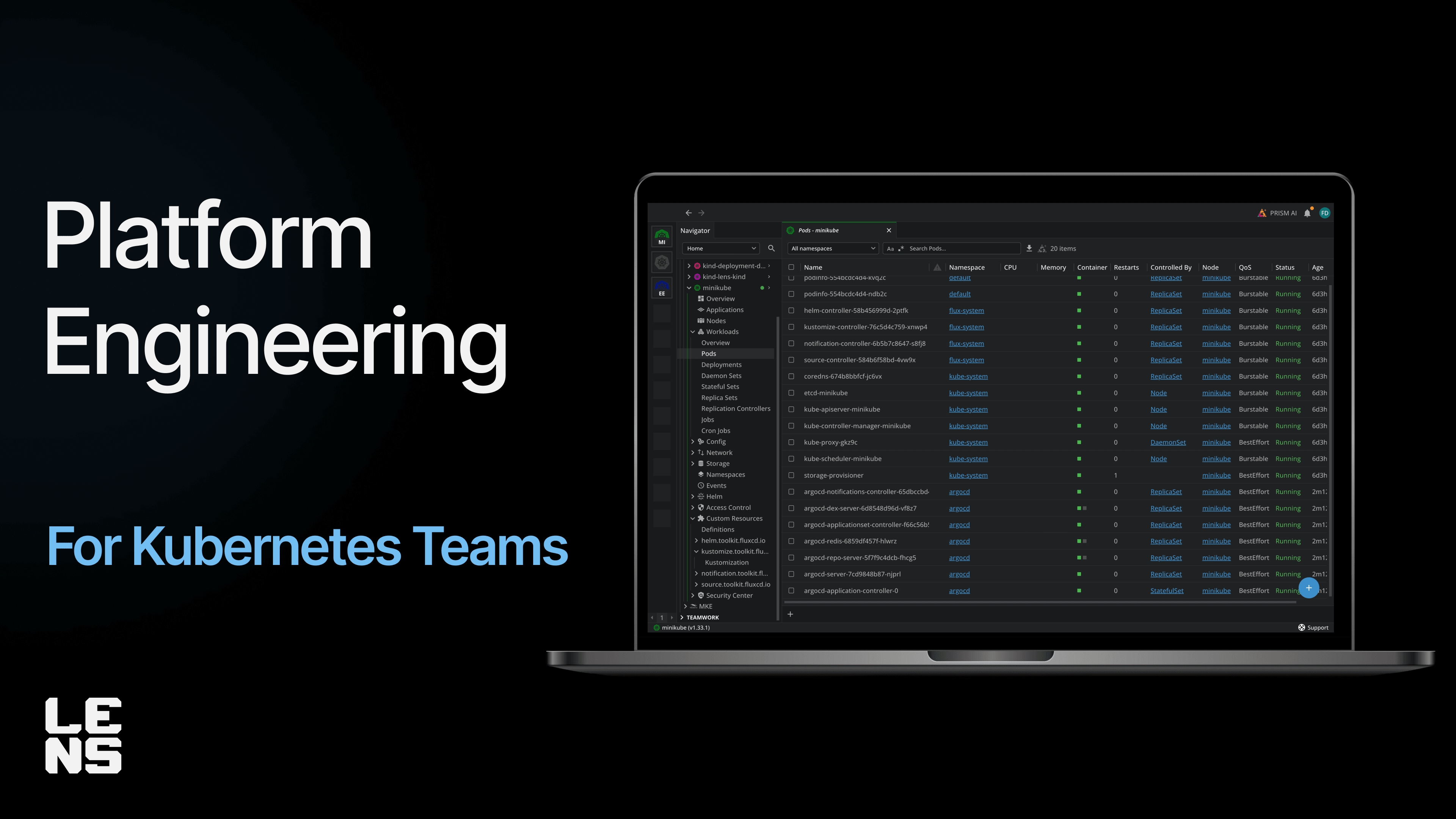
This is where Lens Kubernetes IDE comes in as it helps you:
- Understand, at a glance, what is happening with your Kubernetes resources
- Lets you port-forward to services, see pods logs and events, and also make changes to your resources
- Manage your Helm Charts and Custom Resources
- Understand vulnerabilities by using the built-in security center based on Trivy
- Connect to your cloud clusters with ease by using the built-in integrations with AWS, Azure, and soon GCP
- Has a built-in AI assistant called Lens Prism that is context aware and makes it easy to debug your resources
- Connect to your clusters from any AI assistant using Lens Prism
If you want to learn more about how Lens Kubernetes IDE can help, check out this article.
Conclusion
Platform engineering is a shift that is already happening and makes Kubernetes sustainable at scale. The IDP stack is modular, and you should at least have a developer portal, GitOps, infrastructure provisioning, policy, security, observability, and AI built-in.
Lens Kubernetes IDE completes your platform, and by leveraging Lens Prism you add an AI layer that lets developers ask questions in plain-English and get solutions directly for the problems they are facing.
If you want to learn more about how Lens Kubernetes IDE fits into your platform engineering workflows, book a demo with one of our engineers.